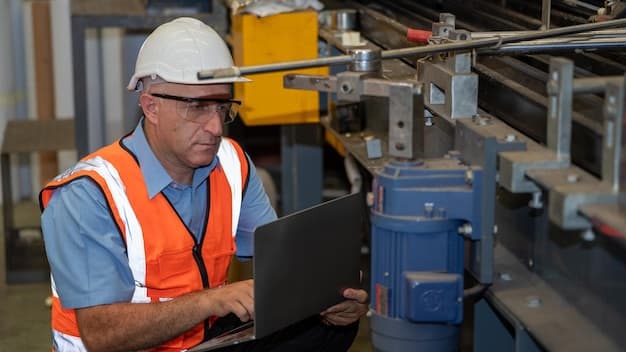
An equipment failure just hit your plant. Production stops. Customers wait. Revenue stalls. In the next 30 minutes, your maintenance team will lose $5,000-$50,000 depending on your operation.
But here's the frustrating part: Many of these failures are preventable. And the ones that aren't preventable can be solved 25 minutes faster. The problem isn't that failures happen. The problem is that most manufacturing plants are unprepared to respond to them.
The Downtime Problem: By the Numbers
Global manufacturing loses $1+ trillion annually to unplanned downtime.
For a $50M manufacturing operation: at 15% downtime, you're looking at $7.5M annual loss. Even a 2% improvement in downtime = $1M+ in recovered revenue.
47% of that failure response time is spent diagnosing the problem, not fixing it. This means nearly half of your unplanned downtime cost is diagnosis time-which is directly controllable.
According to industry data, unplanned downtime breaks down as: 40% equipment failure, 25% operator error, 15% supply chain delays, 12% quality issues, and 8% unknown/other causes.
How to Calculate the True Cost of Unplanned Downtime
Most plants only count lost production when they tally downtime. The real number is higher, because idle labor, scrap, and restart costs pile on top. A more complete hourly figure looks like this:
Worked example. A line that makes 120 units per hour at a $40 margin loses $4,800 in production value for every hour it is down. Add eight operators standing idle at a $45 loaded wage ($360), about $300 of scrap from the failed batch, and $250 to restart and expedite, and the true cost is roughly $5,710 per hour, not the $4,800 most reports show.
Scale that across a year of failures and the gap is large. Siemens' True Cost of Downtime research estimates the world's largest industrial firms lose about 11% of yearly turnover, more than $1 trillion in total, to unplanned downtime. Knowing your own number matters, because you cannot justify a fix until you can size the loss it prevents.
Root Causes of Unplanned Downtime
1. Knowledge Silos
Your best technician knows how to diagnose Equipment A in 15 minutes. Everyone else takes 45 minutes. When that best technician retires or transfers, the knowledge walks out the door. This creates inconsistent diagnosis time, low confidence from younger technicians, repeat failures without documented solutions, and knowledge loss when experienced staff leave.
2026 Solution: Digitize troubleshooting expertise and make it instantly accessible. Capture the "why" behind repairs. Use AI to synthesize your plant's historical knowledge into guidance.
2. Poor Troubleshooting Process
When a failure happens, technicians search for the right manual (if documented), call for expert help (if available), or guess based on experience. This takes 20-30 minutes just to diagnose. Across 100+ failures per year, that's 25-40 hours of lost production.
2026 Solution: Create documented troubleshooting flowcharts. Make procedures searchable and context-aware. Use AI to deliver diagnosis in 90 seconds instead of 25 minutes.
3. Insufficient Preventive Maintenance
Your CMMS schedules preventive maintenance, but coverage gaps exist. Not everything gets maintained on schedule. Equipment runs until it fails. Preventable failures that could have been caught during scheduled maintenance instead happen unexpectedly, with full production impact.
2026 Solution: Implement predictive maintenance for high-value equipment. Ensure your PM schedule covers critical assets. Use equipment reliability data to optimize PM intervals.
7 Strategies to Reduce Unplanned Downtime
Strategy 1: Optimize Your Preventive Maintenance Schedule
Analyze your failure history to understand which equipment fails most often. Categorize by risk: critical (production-stopping failures), major (significant impact), and minor (low impact). Set PM intervals accordingly-critical equipment every 2-4 weeks, major every 6-8 weeks, minor every 12+ weeks. Track mean time between failures (MTBF) before and after optimization.
Expected Impact: 10-15% reduction in equipment-related failures with immediate payback through reduced firefighting costs.
Strategy 2: Implement Predictive Maintenance on Critical Equipment
Use sensors and data analysis to predict failures before they happen. Technologies include vibration analysis (detects bearing failures), thermal imaging (detects overheating), oil analysis (detects wear in hydraulic systems), and power/current monitoring (detects electrical anomalies). Our guide to predictive maintenance ROI walks through how to size the payback before you invest.
Expected Impact: 20-30% reduction in unplanned downtime with 12-18 month ROI. Cost: $5K-$50K depending on equipment count.
Strategy 3: Document and Digitize Troubleshooting Procedures
Create troubleshooting flowcharts for your top 20 failures. Document your SOPs. Capture historical knowledge from past repair logs. Make it searchable and context-aware. Enable natural language search where technicians type what they see, not technical keywords. Our Checklist Generator can help you build these systematically.
Expected Impact: 25-40% reduction in diagnosis time with improved consistency across all technicians.
Strategy 4: Build Technician Skills and Confidence
Provide structured training on your equipment types. Use job aids and visual guides. Create mentorship programs pairing new technicians with experienced ones. Build confidence through success, starting with simpler failures and progressing to complex.
Expected Impact: 15-20% reduction in diagnosis time with improved safety and reduced overtime.
Strategy 5: Reduce Diagnostic Time with AI-Powered Troubleshooting
Use AI that understands your equipment and processes to deliver expert-level diagnosis in seconds. Your documentation (manuals, SOPs, past repairs) is processed by AI. AI learns your equipment and troubleshooting logic. Technician describes problem in natural language. AI instantly returns the diagnostic path and solution. Technician executes fix with confidence and context. Explore our AI Copilot to see this in action.
Expected Impact: Diagnosis time 20-30 minutes → 90 seconds. Accuracy 99.2%. MTTR improvement 40% faster overall. Implementation 2-4 weeks. Cost $29-$69 per technician per month. ROI timeline 4-6 months.
Strategy 6: Create a Spare Parts Strategy
Identify critical spares by analyzing which parts fail most often and have the longest lead times. Maintain strategic inventory of high-failure-rate items. Use data to predict demand. Automate reordering when inventory drops below threshold thresholds.
Expected Impact: 10-15% reduction in downtime with lower procurement costs and better supplier relationships.
Strategy 7: Implement Real-Time Equipment Monitoring
Know the moment equipment starts to fail so you can respond immediately. Install IIoT sensors and edge computing. Set up SCADA systems. Create real-time dashboards. Enable automated alerts. Establish clear response protocols.
Expected Impact: 30-40% reduction in mean time to respond. Cost: $2K-$20K depending on equipment and sensor type.
How AI Helps: The Math Behind Faster Downtime Reduction
Real Numbers Example:
150 unplanned equipment failures per year with average diagnosis time of 25 minutes and repair time of 45 minutes (MTTR 70 minutes). At $5,000/hour downtime: 150 × 70 minutes × ($5,000/60 min) = $875K annual downtime cost
After implementing AI troubleshooting: diagnosis time drops from 25 minutes to 90 seconds. New MTTR ~46 minutes (90 sec diagnosis + 45 min repair). Time saved per failure: 24 minutes.
New annual cost: 150 × 46 minutes × ($5,000/60 min) = $575K. Savings: $300K annually. Payback on $50K investment: 2 months
Case Study: How a Plant Reduced Downtime 35%
A 200-technician manufacturing facility had 18% unplanned downtime (~$14.4M annual cost) and set a target to cut it by 25%.
What They Did: (1) Optimized PM schedule based on failure history, adjusting maintenance intervals, resulting in 12% reduction in equipment failures. (2) Documented procedures for top 20 failures, created flowcharts, digitized SOPs, built troubleshooting guides, reducing diagnosis time by 30%. (3) Deployed AI troubleshooting (Dovient), integrated with existing CMMS, trained technicians, achieving 90-second diagnosis time and 40% MTTR improvement.
Results (90 Days): Unplanned downtime 18% → 12% (33% improvement). MTTR 70 minutes → 42 minutes (40% improvement). Technician confidence +67%. Payback achieved in Month 4. Year 1 savings: $3.2M
Key Metrics to Track
Once you start your downtime reduction initiative, measure: Mean Time To Repair (MTTR) with target 25-40% reduction. Mean Time Between Failures (MTBF) with target 20%+ increase. Unplanned Downtime % with target reduction from 15% to 10%. Repeat Failure Rate with 30%+ reduction. Technician Diagnostic Accuracy with 95%+ improvement. Emergency Overtime Cost with 40%+ reduction. Knowledge Preservation with 95%+ coverage of critical tasks. Try our OEE Calculator to get a baseline.
Frequently Asked Questions
What counts as unplanned downtime?
Unplanned downtime is any unscheduled stop that keeps equipment from running when it should be: breakdowns, unexpected faults, material or operator-caused stops, and the time spent diagnosing and repairing them. Scheduled maintenance and planned changeovers do not count.
What is a good unplanned downtime percentage?
It varies by industry, but well-run plants usually keep unplanned downtime under 10% of scheduled run time, and the best operations sit closer to 2 to 5%. If you are above 15%, the strategies above tend to pay back quickly.
How much does unplanned downtime cost?
Use the formula above for your own figure. As a benchmark, Siemens' research puts the average across heavy industry in the hundreds of thousands of dollars per hour, rising past $2 million per hour in automotive. Remember that diagnosis time is often nearly as long as the repair itself, so it is a large and controllable share of the bill.
What is the difference between MTTR and MTBF?
MTTR (mean time to repair) measures how long it takes to get equipment running again after a failure. MTBF (mean time between failures) measures how often failures happen. You cut downtime by pushing MTTR down and MTBF up, and you can size both with our MTTR and MTBF calculator.
Where should we start?
Start with the repeat failures. Run a structured root cause analysis on your most frequent stops, document the fixes so the next technician inherits them, then shape your preventive maintenance around the failure modes that actually threaten the line. That order removes the most downtime for the least effort.
Conclusion: Your Downtime Reduction Blueprint
Unplanned downtime isn't inevitable. It's a solvable problem with a clear methodology:
- Prevent failures through optimized preventive maintenance
- Predict failures through sensors and predictive analytics
- Diagnose quickly through documented procedures and AI guidance
- Respond fast through skilled technicians and spare parts availability
- Learn continuously through knowledge capture and process improvement
The manufacturers winning in 2026 combine all five-not just picking one or two. You don't have to implement everything at once. Start with Strategy 1 (optimize PM) and Strategy 3 (document procedures). Measure the impact. Then layer in AI troubleshooting (Strategy 5) for accelerated results. Check our ROI Calculator to see your potential savings. A 2% improvement in downtime = $1M+ in recovered revenue.